


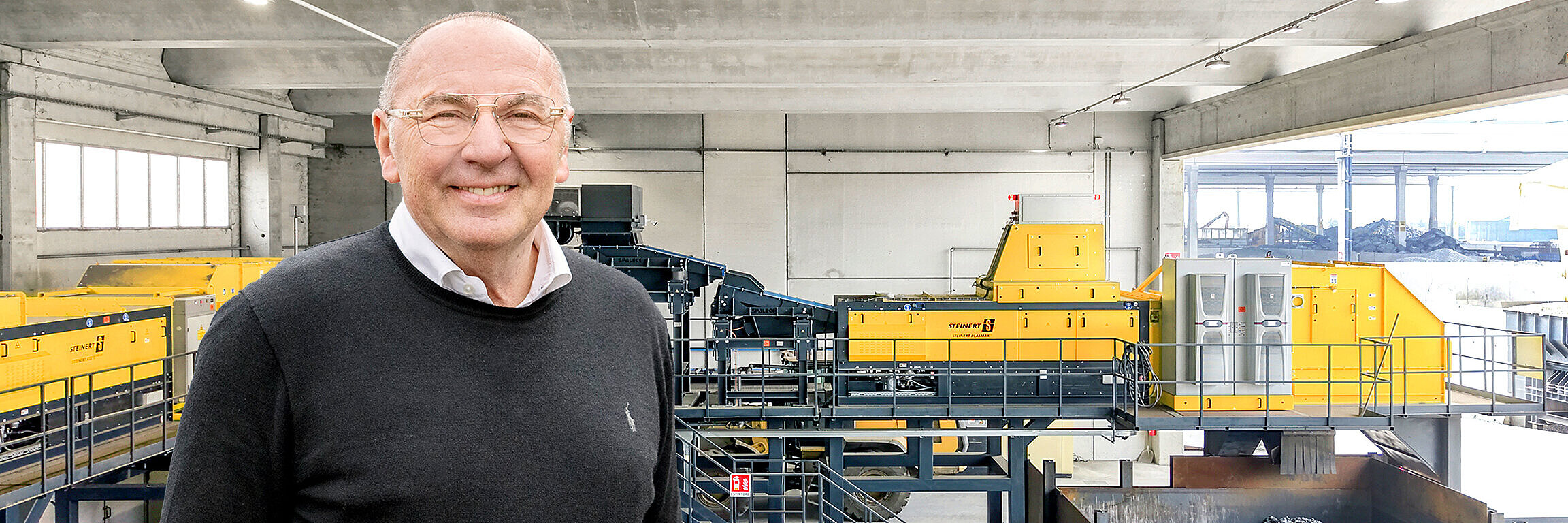
Ten years, five sorting lines, over 99% purity: STEMIN and STEINERT are setting new benchmarks in alloy sorting
High-quality sensor technology meets industrial durability: what STEMIN operates at its Bergamo site is no ordinary recycling plant, but a fully integrated process chain in which sensor-based sorting systems and machine precision work hand in hand to determine the quality of the final product.
Results at a glance
More than ten years of collaboration between STEMIN and STEINERT have delivered measurable results:
- 180,000 tonnes of annual aluminium processing capacity at the Bergamo site – around 17–18% of the Italian secondary market
- Over 99% purity in alloy separation while maintaining stable throughput
- Up to 11 tonnes per hour throughput with the STEINERT PLASMAX
- Up to three alloy fractions in a single sorting run
- 20,000 operating hours warranty on STEINERT X-ray sources (since 2020)
- Remote diagnostics and issue resolution within 30–40 minutes, even without a technician on site

STEMIN: A benchmark in Italian aluminium recycling
Nearly one fifth of Italy’s entire secondary aluminium market passes through a single plant: STEMIN S.p.A., located near Bergamo, processes around 180,000 tonnes of aluminium annually and is therefore one of the most significant players in the country’s recycling industry.
At STEMIN, investment in technology follows a clear principle. President Olivo Foglieni puts it this way: “Technology is absolutely fundamental to achieving environmental objectives – this means lower energy consumption, significantly higher hourly throughput, and reduced production downtime.” For him, profitability and sustainability are not competing goals, but two sides of the same decision.
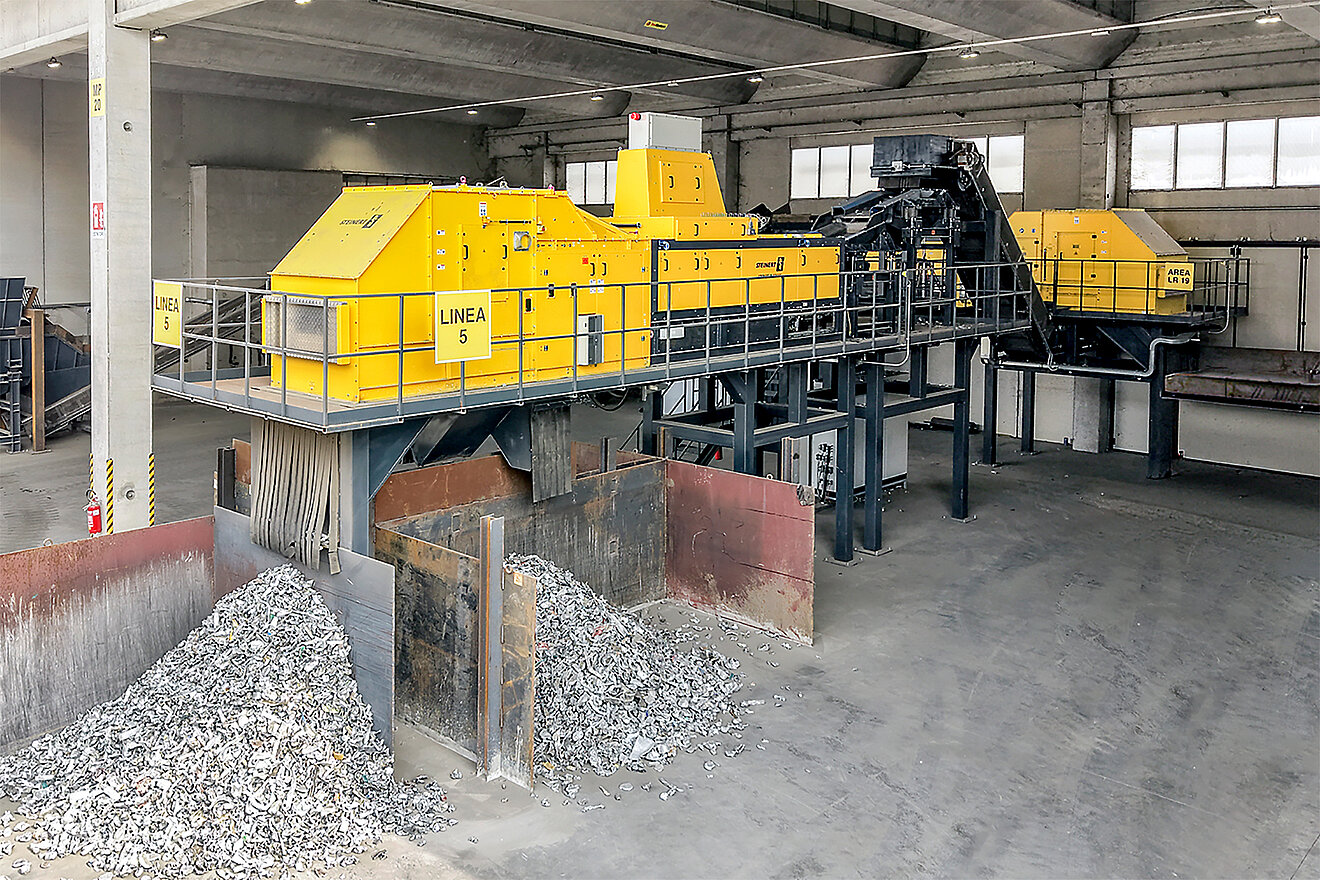
For more than ten years, STEMIN has relied on STEINERT as its technology partner. Today, the plant operates five sorting lines covering the entire process chain: from eddy current separation – an electromagnetic process for separating non-ferrous metals – to sensor-based light/heavy separation and precise alloy classification using the LIBS-based STEINERT PLASMAX.
How does LIBS technology separate aluminium alloys at over 99% purity?
At the heart of the plant is the STEINERT PLASMAX, based on LIBS (Laser-Induced Breakdown Spectroscopy). In this process, a high-energy laser pulse is fired at each individual particle, vaporising the surface and generating a plasma that emits characteristic light signals. Spectroscopic analysis of these signals reveals the exact elemental composition – in milliseconds, for every single piece.
Before the material reaches the STEINERT PLASMAX unit, it passes through several pre-treatment stages at STEMIN to remove plastics, light and heavy metals, and foreign alloys from the stream. The LIBS sensor then analyses each particle according to its chemical composition and assigns it to one of up to three simultaneously generated fractions. The system distinguishes aluminium alloys from the 1xxx to 8xxx series while maintaining throughput of up to 11 tonnes per hour and purity levels consistently exceeding 99%.
The result is furnace-ready alloy feedstock that STEMIN can supply directly to secondary smelters without additional processing. As Foglieni says of the collaboration behind this success: “Two companies with different expertise and perspectives – united, they succeed across the board.”
New upgrade: what grain sizes does the further developed STEINERT PLASMAX unlock?
The STEINERT PLASMAX is continuing to evolve. A new upgrade extends its capabilities to smaller grain sizes, opening up material potential that previously lay outside the economically sortable range.
Companies facing investment decisions can evaluate their own material at the STEINERT Test Center under industrial conditions – on a tonne scale, not just in the laboratory.
Why does service expertise determine the economic availability of modern sorting plants?
Technology is one thing – but in the event of a disruption, response speed is what matters. From the very beginning, Foglieni was looking for a system where “downtime simply isn’t an issue,” and today he describes STEINERT’s service as one of the decisive factors behind every further investment decision.
The basis for this is the full remote connectivity of all five systems: “Within 30 to 40 minutes, we are able to resolve an issue, even when it is not possible to have a technician on site. The most serious issue we have ever encountered was resolved within two hours.”
What emerges from this goes far beyond a traditional supplier relationship. STEINERT actively supports STEMIN in achieving its operational goals – with the commitment that the plant is “never left on their own.”


STEINERT Test Center: from material sample to investment certainty
Every system now running in Bergamo first went through the STEINERT Test Center in Cologne. For Foglieni, this is not a formality, but a critical tool for investment certainty: “This is extremely important for us: being able to verify what can and cannot be recovered from our specific material — not in kilograms, but potentially in tonnes.”
What sets it apart from a traditional showroom is its practical relevance: real materials, industrial-scale equipment, and technical support from STEINERT specialists. “The machines, the technicians, and the range of experimentation possibilities were impressive. That is precisely why, on many occasions before making a purchase, we carried out multiple tests at their Test Center in Germany.”
Ten years, five sorting lines, one conclusion
One decade, five installed sorting lines, one verdict: when asked to describe the collaboration with STEINERT in a single word, Olivo Foglieni answers without hesitation: “Reliability.”